
Concurrency programming can be reduced to three questions: How do we divide work? How do tasks coordinate? How do we protect shared state? Languages and runtimes provide threads, coroutines, event loops, actors, and channels, but none of these tools creates correctness by itself.
Production systems must also control task lifetime, resource limits, deadlines, cancellation, backpressure, and partial failure. When these constraints are designed together, concurrency becomes a system that can be reasoned about, observed, and controlled—not merely a way to run several tasks at once.
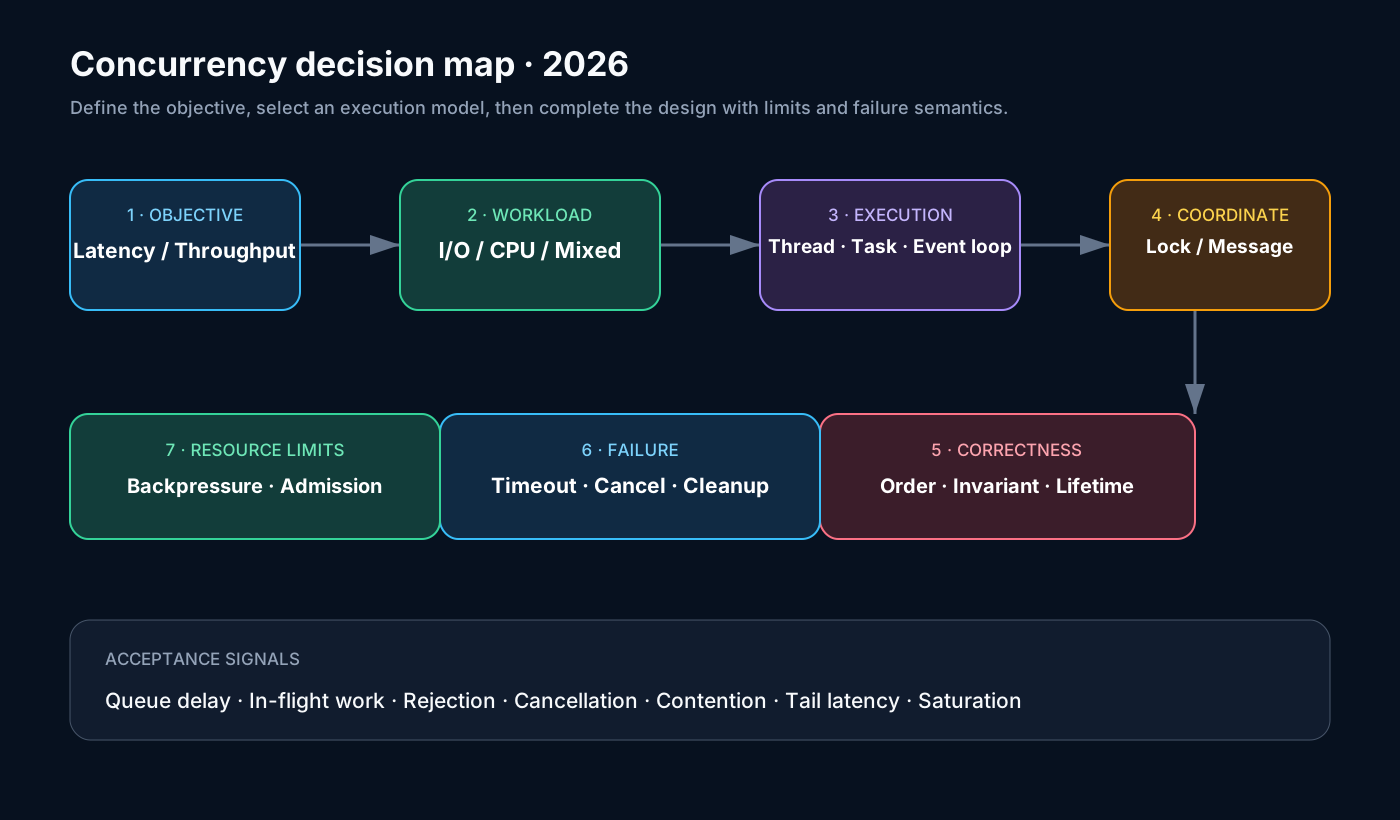
Separate the concepts first
Concurrency means tasks overlap in time and require coordination. Parallelism means tasks actually execute simultaneously. A single-core event loop can be concurrent without executing Python code in parallel; workers on multiple cores may provide both.
Synchronous/asynchronous and blocking/non-blocking are also independent axes. The former mostly describes control flow and result delivery. The latter asks whether a calling thread stops when an operation cannot complete immediately. A non-blocking call may return a status, handle, or incomplete result—not the final value. An asynchronous API may still block an internal worker.
Processes provide separate address spaces and fault boundaries. Platform threads share process memory and are scheduled by the operating system. Goroutines, Java virtual threads, and asyncio Tasks are lighter runtime-managed units, but they do not share one implementation or one set of semantics.
A coroutine is not atomic. It yields at suspension points; two tasks performing read-modify-write operations around an await can still violate an invariant. A single event-loop thread removes simultaneous multicore execution, not logical races.
Memory models are about ordering
Concurrency bugs commonly arise from visibility, atomicity, and ordering. The reliable way to reason about them is through the language memory model and explicit happens-before relationships, not assumptions about a particular CPU cache.
Java defines volatile through its memory model: a write to a volatile field happens-before a subsequent read, establishing visibility and ordering. It does not make a compound operation such as count++ atomic. Locks, thread start and termination, and concurrent collections establish other ordering guarantees.
Go has different syntax but the same fundamental requirement. Concurrent access to one location with at least one write must be serialized using channels, sync, or sync/atomic. The official memory model gives excellent advice: if proving correctness requires clever memory-model reasoning, simplify the design.
Locking rules should be protocols, not slogans. Multiple locks, lock striping, read-write locks, and optimistic concurrency can all be correct. Every shared state item needs a clear and consistently followed protocol; when several locks protect one invariant, acquisition order and deadlock behavior must be proven.
Java: virtual threads change cost, not correctness
Virtual threads became final in Java 21. High-throughput I/O services can dedicate a virtual thread to a task while retaining straightforward blocking code and useful stack traces.
Virtual threads do not accelerate CPU-bound work beyond available cores. They also should not be pooled merely to limit concurrency. Limit the scarce resource—database connections, remote API quota, memory, or file descriptors—with semaphores, connection pools, and rate limiters.
var permits = new Semaphore(64);

try (var executor = Executors.newVirtualThreadPerTaskExecutor()) {
    var future = executor.submit(() -> {
        permits.acquire();
        try {
            return callDownstream();
        } finally {
            permits.release();
        }
    });
    return future.get();
}
Structured Concurrency remains a preview API in Java 25, so its surface should not be presented as permanently finalized. Its direction is what matters: parents own children, scope exit waits for subtasks, sibling work can be cancelled after failure, and deadlines and errors follow a task tree rather than leaving orphaned Futures.
Go: a channel is not a durable message broker
Goroutines and channels still provide a concise way to express collaboration. A matched send and receive, or closing a channel and observing that close, establishes synchronization. Channels carry ordering as well as values.
“Share memory by communicating” does not mean every counter requires a channel. Channels are natural for work streams and ownership transfer. A mutex is often clearer for a short critical section around one object; atomic operations fit small counters and flags.
Production code must answer questions tutorials often omit: Who closes the channel? What is its capacity? What happens when consumers slow down? How does cancellation propagate? How do goroutines exit? Pass deadlines and cancellation through context.Context, and keep queues bounded so “asynchronous” does not become unbounded memory growth.
Python: the GIL is no longer a one-line answer
With default CPython, asyncio or threads remain appropriate for I/O-bound work, while CPU-heavy pure Python commonly uses processes, native extensions, or external compute. Since Python 3.13, however, CPython has offered an optional free-threaded build that can run Python threads in parallel across cores. It is not automatic acceleration: some extensions may re-enable the GIL, and both safety and performance require testing.
For asynchronous programs, asyncio.TaskGroup expresses a group of tasks that share a lifetime. Leaving the scope waits for all children; the first non-cancellation failure cancels siblings and errors are aggregated. Cleanup belongs in try/finally, and CancelledError should normally be re-raised after cleanup.
async def load_dashboard():
    async with asyncio.TaskGroup() as group:
        user = group.create_task(load_user())
        projects = group.create_task(load_projects())
    return user.result(), projects.result()
Never run blocking I/O directly on the event loop. Use an asynchronous driver or isolate legacy blocking code with asyncio.to_thread(). Route CPU work to a process pool, a tested free-threaded runtime, or an external executor according to the deployment.
From concurrency models to structured lifetimes
Reactor, Future, Callback, Actor, and CSP still solve different problems. Reactor dispatches ready events. Future represents a later value. Actor contains mutable state behind a mailbox. CSP coordinates processes through communication.
The major modern addition is that task lifetime must be modeled too. A concurrent task should not outlive the request that created it unless ownership is deliberately transferred. Structured concurrency forms a task tree so completion, failure, cancellation, and observability have explicit parent-child relationships.
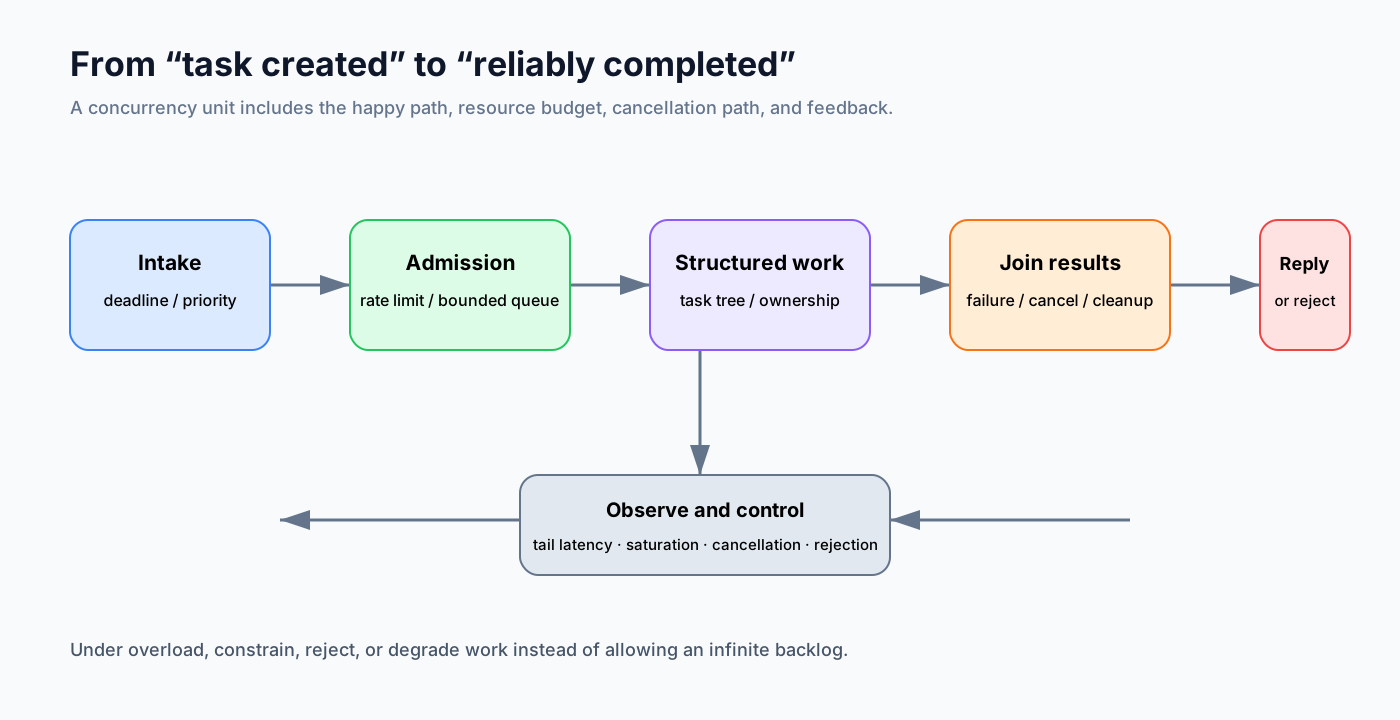
Eight production rules
- Define the objective: lower latency, higher throughput, and fault isolation require different designs.
- Classify the work: measure I/O wait, CPU work, and mixed workloads before choosing concurrency.
- Limit work in flight: lightweight tasks do not make connections, memory, descriptors, or quotas infinite.
- Bound every queue: capacity, overflow policy, priority, and discard semantics must be explicit.
- Propagate deadlines and cancellation: timeout is an end-to-end budget, not a collection of unrelated timers.
- Assign state ownership: prefer immutable values, single writers, and transfer; synchronize shared mutable state.
- Observe failure and saturation: record queue delay, in-flight work, rejection, cancellation, lock contention, and downstream latency—not just average QPS.
- Test interleavings: use race detectors, stress tests, fault injection, and virtual time to cover timeout, cancellation, retry, and partial failure.
Patterns still matter—with limits
Immutability remains the best default for reducing shared-state complexity. Copy-on-write fits read-mostly data, not large collections with frequent writes. Thread-local state requires cleanup with reused platform threads and should not become a large cache on virtual threads. Worker pools are valuable for resource isolation and capacity control, not merely thread reuse.
Producer-consumer is particularly easy to misuse. A queue decouples producers and consumers, but it cannot eliminate a sustained rate mismatch. If average production exceeds consumption, a bounded queue fills and an unbounded queue exhausts memory. The solution is backpressure, rejection, degradation, scaling, or less input—not another queue.
A 2026 definition
Concurrency programming is not simply “doing more things at once.” It is managing the lifetime and state relationships of multiple tasks under finite resources and uncertain failure.
Threads, locks, channels, and execution models are implementation tools. Scopes, cancellation, backpressure, resource budgets, and observability are equally important parts of the design. Concurrency is easier to create than ever; that makes constrained concurrency more important than ever.
A mature system is not one that can start a million tasks. It knows how many should start, when they must stop, whose failure affects whom, and how overload remains controlled.